
Paratope-PLUS® IP: Data for Antibody Patent Protection
Meet enablement and written description requirements after Amgen v. Sanofi
Home » Paratope-PLUS CDR-Scanning » Protecting Antibody IP
Experimental Data to Enable Your Antibody Claims
The 2023 Amgen v. Sanofi decision changed what it takes to patent protect an antibody. Broad functional antibody genus claims are no longer allowed. USPTO enablement and written description requirements now call for experimental enablement of the full genus you’re claiming.
Paratope-PLUS IP was designed to meet exactly that standard. We build and test ~1,000 antibody variants to identify equivalent forms of your parental antibody, delivering a comprehensive dataset that defines a structural genus. It’s grounded in experimental reduction to practice and real wet-lab data.
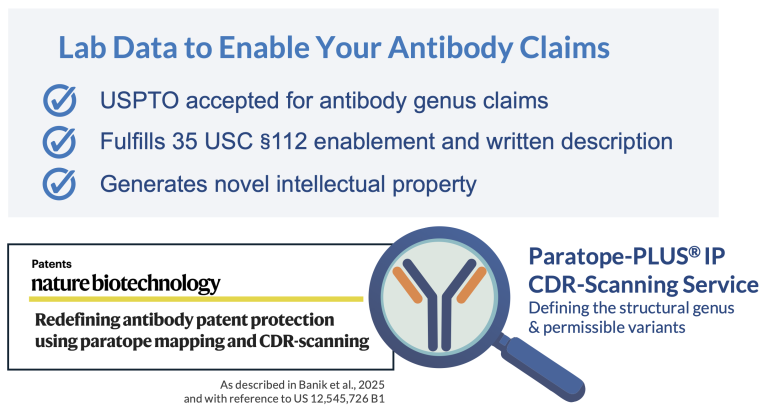
This approach has a proven track record with the USPTO: a patent using our CDR-scanning strategy has now been issued. Developed in collaboration with patent attorneys and published in Nature Biotechnology, Paratope-PLUS IP is the only commercial service that generates the complete dataset required for fully enabled structure-based antibody genus claims. And the same dataset can also support novel IP development for your scientific program.
Learn more about the approach and download the Nature Biotech paper.
Structure-Based Antibody Patent Claims: A Post-Amgen Solution
For many years, antibody inventors used functional genus claims to protect their antibody IP, defining a genus by what it binds. But following Amgen v. Sanofi and subsequent Federal Circuit decisions in Xencor and AbbVie v. Janssen, broad functional antibody genus claims are no longer viable in the US.
The USPTO’s January 2024 guidance reinforced this, but it did not prescribe any technical approach for meeting the new requirements.
The solution is to craft fully enabled structure-based genus claims. And Paratope-PLUS IP is the only commercial service that generates the necessary data to support them.
By systematically making and testing all 19 possible amino acid substitutions at each CDR position, we identify the paratope—the residues required for target binding—which serves as the common structural feature that defines the genus. We also experimentally identify the substitutions at each position that retain the antibody’s ability to bind the target molecule. Importantly, claims were also allowed by the USPTO for single-residue variants in combination, offering protection across an even greater set of species within your genus.
Your project report will include binding data for all variants, and it will highlight the critical residues and permissive substitutions. We also provide draft patent claims that mirror the Markush-style claims in the issued GPCR5D patent (see case study below).
The Paratope-PLUS IP dataset:
- Demonstrates actual possession of the full genus
- Can be used flexibly, for example to support means-plus-function claims
- Mitigates §103 (non-obviousness) issues

Paratope-PLUS uses deep mutational scanning to identify an antibody’s paratope: the common structural feature that defines the genus.
Building on a Small-Molecule Drug Approach
Working with antibody IP experts, and guided by case law and available technology, we identified a strategy for obtaining robust patent protection for a genus of related antibodies. This strategy begins with an approach commonly used for claiming a genus of small-molecule drugs: define a core chemical scaffold, along with R-group substitutions that preserve the molecule’s function (also known as permissible substitutions).
Applying this approach to antibodies, the antibody paratope (the amino acids that contact the target antigen) defines the core common structure of the genus of antibodies. And the amino acid substitutions in the antibody’s CDR region that permit target binding constitute the permissible substitutions.
But our approach goes a step further. Using high-throughput experimental methods, we make and test the large number of antibody CDR variants required to gather the necessary binding data—a process we call comprehensive CDR-Scanning. This step is essential for both identifying permissible substitutions and demonstrating possession of the invention.
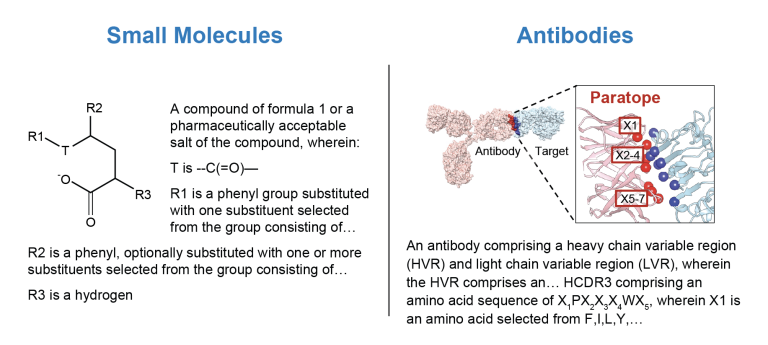
Our antibody genus claims strategy builds on an approach commonly used for small molecules. Antibody patent claims are based on the paratope as the common structural feature, along with permissible amino acid substitutions that retain target protein binding.
Generate Novel IP and Parallel Antibody Engineering Insights
The same dataset that defines your genus claims also delivers antibody-engineering insights into variants with improved properties.
Our comprehensive deep mutational CDR scanning approach identifies substitutions that improve antibody binding affinity, providing the scientific basis for novel composition claims that are independent of your original sequence claims. This makes Paratope-PLUS IP data a dual asset: it protects what you have and informs where you can go next.
- You’ll always receive affinity data across ~1,000 CDR variants, immediately usable by your scientific team.
- Optionally, screen in parallel or as a follow-up for species cross-reactivity, developability improvements, and other characteristics relevant to your program.
- Gain insights for developing a patentable next-generation antibody, forming the basis for Jepson claims and improvements on prior art post-Xencor.
| One Dataset for Many Uses |
|---|
| ✓ Antibody IP Protection |
| ✓ Improved affinity for the target |
| ✓ Species cross-reactivity |
| ✓ Antibody developability improvements |
Scientific Rigor Alongside Privacy and Data Security
Paratope-PLUS IP is a cost- and time-efficient service thanks to streamlined methods and extensive automation, while meeting the highest scientific and privacy standards.
Scientific rigor. Integral Molecular has a long history with antibody science. Our team of PhD-level scientists brings more than 20 years of experience engineering antibodies, and our CDR-scanning approach has been published in Nature Biotechnology (Banik et al., 2025; download the paper). We co-developed this strategy in collaboration with patent attorneys and IP experts, and a patent using this approach has been issued by the USPTO.
Privacy and data security. We understand that your antibody sequence data is among your most sensitive IP. Access to project data is strictly limited to the team members who need it, and all personnel working with client data are bound by confidentiality agreements. Our data storage systems are designed to keep your information secure throughout the project and beyond. As a Philadelphia-based, US-owned company, Integral Molecular operates under US law, providing a clear and enforceable framework for IP protection and confidentiality obligations.
Under our fee-for-service model, you retain full ownership of all data and findings the project generates around your propriety antibody. Any novel IP arising from the project is yours to pursue.

Case Study: Structure-Based Genus Claims for a Therapeutic Antibody
GPRC5D is a receptor protein expressed at high levels in multiple myeloma cells and largely absent from healthy tissue, making it a compelling target for therapeutic antibodies. Integral Molecular developed a novel GPRC5D antibody and applied Paratope-PLUS IP to characterize its full variant landscape.
By making and testing all 19 possible amino acid substitutions at each CDR residue, we identified the residues required for GPRC5D binding—the common structural feature of the antibody genus—along with all permissive substitutions across the CDRs. This dataset supported structure-based genus composition claims defining the antibody and its functionally equivalent variants.
US Patent 12,545,726 has been issued, providing demonstrated precedent for this claims strategy with the USPTO.
An annotated version of the patent is available for download as a PDF. This document includes examiner comments on the allowed claims and other context you won’t find on the USPTO site.
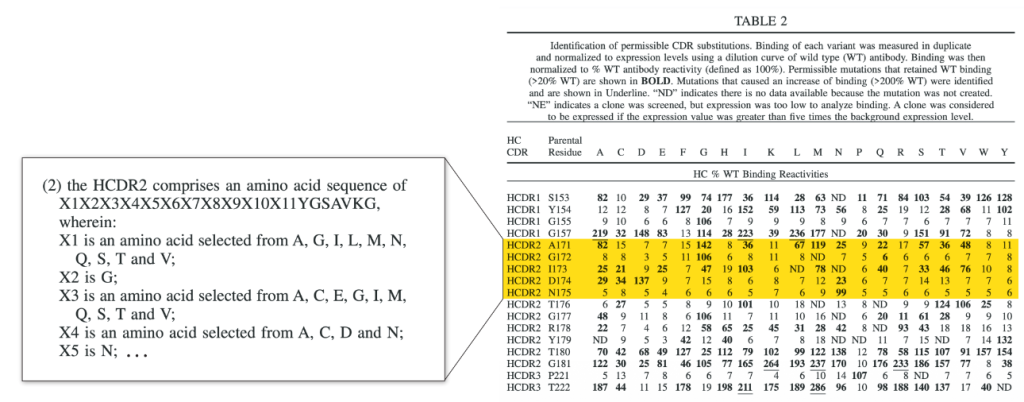
CDR variant binding data directly informs antibody claims. Adapted from US Patent 12,545,726 (Integral Molecular, Inc.)
Featured Webinar: Resurrecting Antibody Genus Protection
New antibody patenting strategies, including as structure-based genus, are reshaping how antibody genus claims are being written post Amgen v. Sanofi. The webinar panelists discussed the shifting antibody IP landscape and examples of genus claims recently allowed by the USPTO based on CDR-scanning data. Watch the recording.
Frequently Asked Questions
Paratope-PLUS IP is the only approach that generates the complete experimental dataset required to support fully enabled genus claims. It supports USPTO requirements for both enablement and written description under 35 USC §112. And the final report includes draft patent claims, giving your patent attorneys a head start in translating your data into actionable patent language.
For a comparison with other antibody IP strategies, see Banik et al., 2025, Table 3. Download the paper.
Yes. A patent using this strategy has been issued by the USPTO, providing demonstrated precedent for structure-based genus claims developed using Paratope-PLUS CDR-scanning data. This acceptance also demonstrates that our data meets USPTO antibody patent guidance requirements. Download the annotated patent, including the patent examiner’s comments.
We make and test all 19 possible amino acid substitutions at each residue in your antibody’s complementarity-determining regions (CDRs), approximately 1,140 individual variants for a typical IgG antibody. This identifies the critical paratope residues (those that cannot be changed without losing binding), along with all substitutions at each position that retain the antibody’s ability to bind its target. Together, these define the structural genus: a common structural feature plus every allowed variant within the CDRs. This builds off the long-accepted compositional claims format used for small-molecule drugs (scaffold plus permissible R-group substitutions).
Yes. We make and test all variants in our laboratory. This is a critical distinction: the USPTO and courts have made clear that computational predictions alone are not sufficient to satisfy enablement and written description requirements.
Claims for combinations of single-residue variants have been allowed using this approach, for protection across an even broader set of antibody species within your genus. To see the allowed claims, download the annotated patent.
We recommend discussing specific claims strategy with your patent counsel.
Integral Molecular is a Philadelphia-based, US-owned company. Your sequence data is stored in a secure data storage system and is never shared outside the engagement.
Yes. Under our fee-for-service model, you retain full ownership of all data and findings that Paratope-PLUS generates around your propriety antibody. Any novel IP arising from the project is yours to pursue.
No. Integral Molecular provides the experimental dataset and a report that includes draft patent claim language. Your patent attorneys are responsible for filing and prosecuting the claims. We work closely with your legal team to ensure the data and draft language are ready to use.