
CDR Saturation Mutagenesis for Species Cross-Reactivity with Paratope-PLUS®
Use deep mutational scanning to improve your antibody’s ortholog binding
Home » Paratope-PLUS CDR-Scanning » Paratope-PLUS Application – Species Cross-Reactivity
Achieve Species Cross-Reactivity with Paratope-PLUS
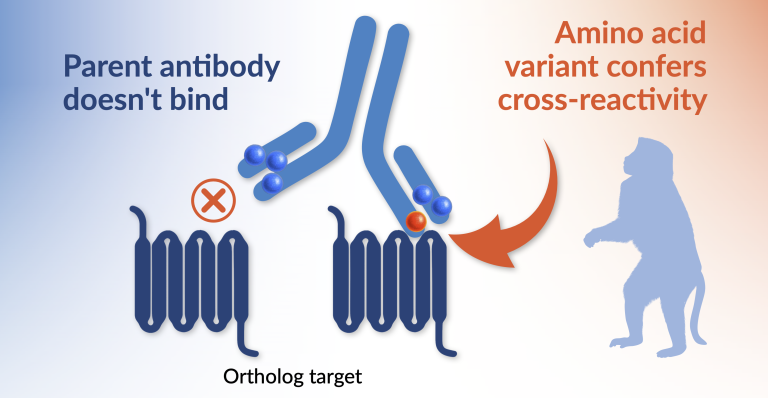
Robust binding to both human and ortholog targets is crucial for IND-enabling safety and efficacy studies but it isn’t always easy to achieve. If your therapeutic antibody candidate lacks cross-reactivity with your preclinical model species, we can help. Our Paratope-PLUS CDR-scanning service provides variants of your antibody for improved ortholog affinity—while retaining and even improving its affinity for the human target.
You’ll receive a comprehensive dataset that includes experimental binding data for every possible single-residue variation in your antibody’s CDRs. This dataset can serve as a high-resolution foundation for affinity maturation, helping you identify amino acid substitutions that enhance binding across species or improve human target engagement. Often, even a single substitution can significantly improve ortholog cross-reactivity. And the same dataset provides insight into other antibody improvements for downstream development.
Gain Insights Beyond Species Cross-Reactivity
Because Paratope-PLUS builds and tests each possible CDR variant individually, it yields a rich dataset that can inform antibody engineering improvements across multiple parameters in parallel. Paratope-PLUS data is a goldmine for guiding rational antibody design and training AI/ML affinity models, as well as protecting antibody intellectual property in the post Amgen v. Sanofi landscape. Our multi-parametric approach offers distinct advantages over other affinity maturation strategies, which typically select for just one characteristic at a time.
| One Dataset for Many Uses |
|---|
| ✓ Species cross-reactivity |
| ✓ Improved affinity for the human target |
| ✓ Antibody developability improvements |
| ✓ AI/ML model training and validation |
| ✓ Antibody IP protection |
Case Study: Increased Reactivity with Cynomolgus Ortholog Enables Access to Preclinical Animal Models
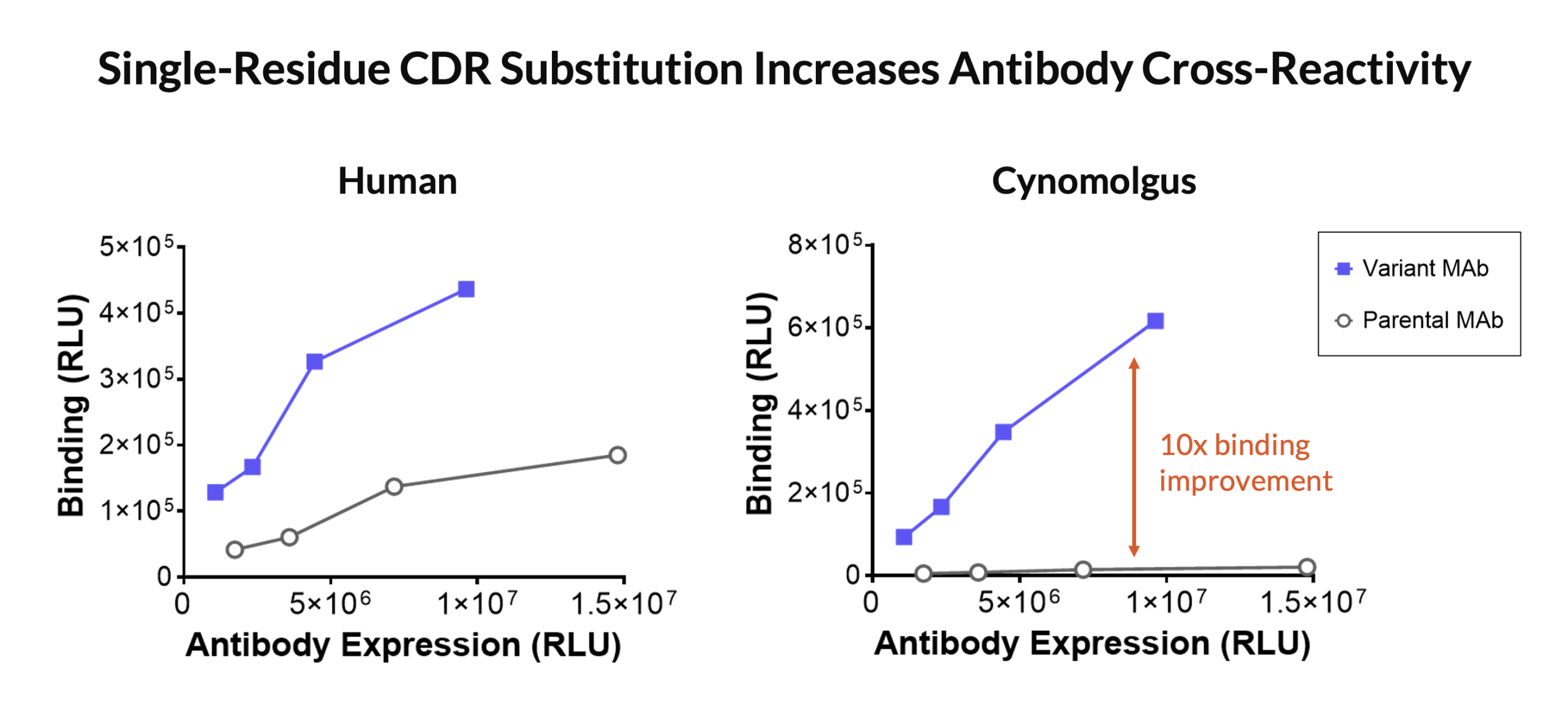
This project started with a therapeutic antibody candidate that had minimal cross-reactivity with the cynomolgus ortholog (the preclinical species homolog). Paratope-PLUS revealed multiple single-residue substitutions that improved ortholog binding over ten-fold. The data below shows a CDR variant substitution with improved affinity for both the human and cynomolgus targets (blue lines) as compared to the parental antibody (gray lines).
Paratope-PLUS delivered the data necessary to engineer the antibody for species cross-reactivity with the preclinical animal model, advancing development and eliminating the need for a surrogate antibody.
Workflow & Deliverables: A High-Throughput, Comprehensive Approach
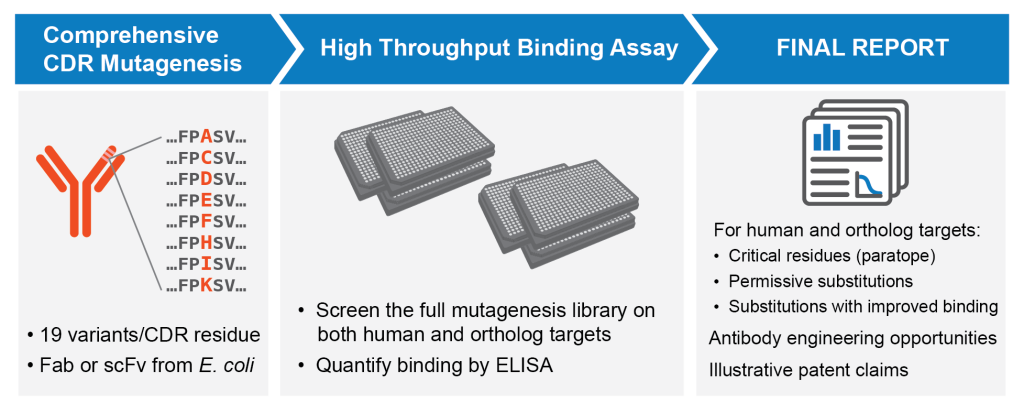
Paratope-PLUS leverages Integral Molecular’s proven expertise in high-throughput mutagenesis and protein-protein mapping to deliver a comprehensive antibody optimization package at an affordable price. We systematically build every single-amino-acid substitution in your antibody’s CDRs using saturation mutagenesis (deep mutational scanning). Then each variant undergoes a quantitative binding analysis in a high-throughput array format. Unlike selective mutagenesis approaches that test only a subset of mutations, Paratope-PLUS offers a comprehensive dataset that enables parallel enhancement strategies.
Your project deliverable is a Final Report with quantitative binding and expression data for all variants tested, data visualizations that highlight key insights, and draft patent claims for defining a genus of related variants.
For more information about the Paratope-PLUS platform, our expertise in antibody mapping and protein engineering, and more frequently asked questions, follow the link below.
Frequently Asked Questions
If your antibody has measurable binding to the human target in a cell-based assay or ELISA, and ideally some detectable interaction with the non-human ortholog, then it’s a good candidate. Your project will have the best chance of success if your antibody has some binding to the ortholog, even weak or partial binding.
Yes. By testing all single-residue substitutions across the CDRs, Paratope-PLUS can identify variants that maintain or improve binding to the intended target while losing binding to an anti-target, such as a structurally similar homolog. This approach effectively selects for antibody variants with greater specificity, which is critical when the anti-target is a physiologically important molecule.
Affinity maturation with Partope-PLUS can work for orthologs from any species—but you’ll have the best chance of success if you begin with an antibody that has some binding to the ortholog target, even if the affinity is very low.
Display methods assess binding in a pooled competitive format for one property at a time. In contrast, Paratope-PLUS individually measures binding and expression for each variant, providing parallel data sets of information for every single mutation. With this high-resolution, unbiased data, Paratope-PLUS informs protein engineering improvements across multiple properties simultaneously while also providing critical information for protecting antibody IP. Display techniques suffer from additional limitations that do not plague Paratope-PLUS, including biased selection, limited coverage of combinatorial mutations, and difficulties working with complex or poorly expressing proteins.
To initiate a Paratope-PLUS species cross-reactivity project, you’ll need to provide the antibody’s CDR sequence and specify which regions you want scanned, e.g., all six CDRs or only the heavy chain. We’ll also ask you to complete a project setup form so we can understand how the antibody has been expressed and tested, including formats, expression systems, and whether it’s been used in high-throughput ELISA. Integral Molecular covers up to a certain amount for recombinant antigen sourcing, with any additional antigen costs passed through with prior approval.
Paratope-PLUS is an excellent method for achieving cross-reactivity when you already have a lead candidate. Another option is to prioritize species cross-reactivity at the antibody discovery phase. Our MPS Antibody Discovery platform uses chickens, an evolutionarily divergent host, to generate antibodies against highly conserved targets. With MPS, we can design a discovery strategy to achieve high affinity to human and preferred ortholog targets from the beginning. We have used this approach to develop antibodies that cross-react with homologs across a broad range of mammalian species, including rodents, marmosets, pigs, bats, and more.