


MPA+IND SERVICE FOR REGULATORY SUBMISSIONS

FDA-Recognized Off-Target Specificity Test for Biotherapeutics

Read Specificity Insights, our editorial series on antibody specificity testing and our FDA qualification journey.

Submission-Ready Specificity Data for IND-Enabling Studies

When regulatory agencies evaluate your IND submission, they demand rigorous evidence that your drug candidate selectively engages its intended target without unexpected off-target interactions. Immunohistochemical methods often fail to detect these critical reactions, leading to potential safety risks.

Our MPA+IND service is designed to deliver the actionable specificity data that regulators are looking for. It uses the Membrane Proteome Array (MPA), our proprietary cell-based protein array, to screen drug candidates for binding against the human membrane proteome. Because the MPA uses native, unfixed conditions and delivers quantitative results, its data quality far surpasses that of any competing technology. For the most comprehensive picture of your molecule’s specificity, we also offer screening on our 1,200-protein Secreted Proteome Library.

The MPA+IND service goes several steps beyond what’s offered in our standard MPA service for lead selection. It includes additional replicates and controls, an IND-ready study report, QA documentation, audit support, and more—all on an accelerated, 4-week timeline. And regulators trust our data: it has been accepted by the FDA, EMA, NMPA, and other agencies—including in over 100 IND filings.

Standard MPA specificity testing service is for selecting among 4+ lead candidates. MPA+IND service provides additional features and deliverables for 1-3 molecules ready for IND, with results ready in 4 weeks.

"Integral Molecular’s membrane protein array (MPA) is a key part of our biologics' programmes. It forms a major determinant in our candidate selection criteria, and in recent programmes we have begun to move it earlier to help guide our engineering and optimization efforts. The data and reporting are ever clearer, and the customer service is excellent. The team I regularly work with is responsive and able to get into all the detail you need. I really value our relationship with the Integral Molecular team and the data they provide."

Built for Regulators with Input from the FDA

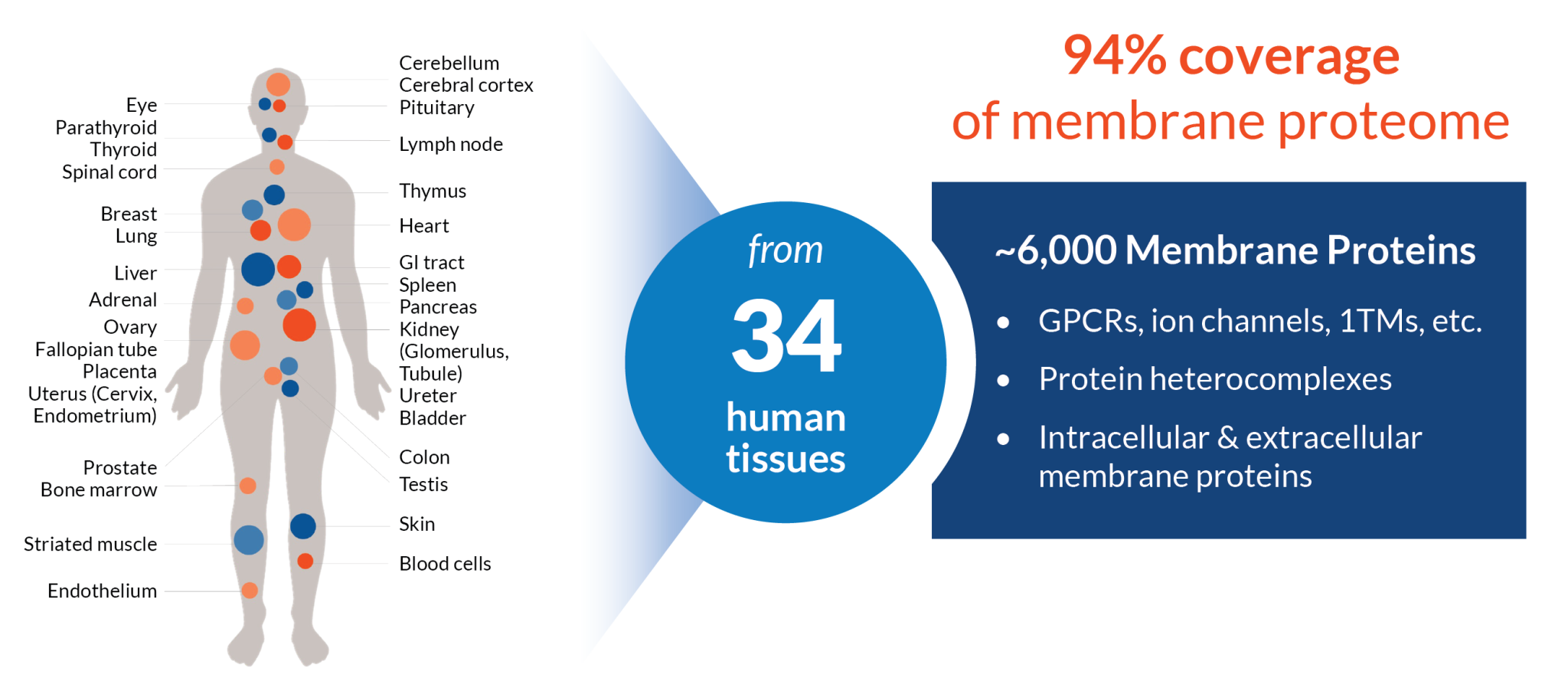
The Membrane Proteome Array (MPA) was purpose-built to meet FDA guidance on specificity testing, and it is nearing FDA qualification as a Drug Development Tool (DDT). The MPA’s 6,000-protein library is based on the membrane proteins present in all 34 tissues recommended in the FDA’s 1997 document on biotherapeutic safety. It represents 94% of the human membrane proteome, ensuring thorough coverage of potential off-target binding sites.

Since 2022, we have been working with the FDA to qualify the MPA as a DDT under the ISTAND program. Through this process, we have conducted numerous validation experiments, demonstrating that MPA results are highly reproducible, show a low false negative rate, and follow rigorous quality control practices. We have submitted all required documents and expect final FDA qualification in 2026.

To learn more about relevant regulatory guidance, the MPA’s progress toward FDA qualification, and what qualification could mean for your program, visit Using MPA Data for Regulatory Success.


MPA_library-guidance

Data that Exceeds what Traditional Methods Can Offer

Traditional tissue cross-reactivity (TCR) studies have been used for decades to show where in the body antibody-based therapeutics bind. Yet TCR studies alone provide limited predictive value for drug safety. They have well-known limitations (Leach et al., 2010), they can be difficult to interpret, and toxicologists say TCR results rarely impact development strategies (MacLachlan et al., 2021). Importantly, they cannot identify the specific proteins bound.

Because the Membrane Proteome Array (MPA) delivers quantitative results that precisely identify any target and off-target proteins a biotherapeutic binds, its results are immediately actionable. MPA data will be an important addition to the weight of evidence supporting your molecule’s safety profile. And if your MPA screen does reveal a validated off-target, our Enhanced Binding Analysis follow-up service provides deeper insights into its potential risks. Analyses include relative binding strength and subcellular and tissue distribution to help you assess whether the off-target protein is accessible to your drug.

To learn more about antibody off-target binding and how the MPA stacks up against TCR in detecting it, visit Antibody Polyspecificity: How to Identify Off-Target Binding for Antibody-Directed Biotherapeutics.

The MPA is the only specificity testing platform to identify off-target proteins, use native-conformation proteins in unfixed cells, provide quantitative statistical analysis, and include validation. Tissue cross-reactivity and protein array alternatives fall short on nearly every measure.

The MPA is the only specificity testing platform to deliver quantitative results, and it’s the only cell-based protein array to screen exclusively on native, unfixed proteins expressed in whole cells.

Project Deliverables

While MPA+IND projects follow the same general workflow as our standard MPA projects, MPA+IND projects include several additional features and deliverables that increase their value and provide the necessary rigor for regulatory submissions.
  • Accelerated turnaround: 4-week delivery from sample receipt
  • Submission-ready data package
    • Validation control antibodies included
    • IND-ready report
    • Test sample QC (DLS)
    • Enhanced statistical analysis
  • IND-level quality assurance
    • FDA-guided data package
    • Audit support
    • Complete data traceability
    • QA documentation
All MPA+IND projects are carried out in our lab in Philadelphia, PA, USA, using ISO 9001 certified processes. The MPA meets the highest standards for scientific rigor and data quality. MPA data is quantitative at every stage of testing, its results are highly reproducible, and it has an industry-leading low false negative rate. Integral Molecular’s building at One uCity Square in Philadelphia. MPA scientists working in our high-throughput lab.

Featured Resources

Novel CAR-T Therapy for Solid Tumors
FDA accepts MPA specificity data in IND application for novel
CAR-T therapy, allowing clinical studies to begin
     Best Practices for Antibody Specificity Testing for IND Submissions
MPA-Fierce-Webinar-2025-Email
Experts discuss the latest on polyspecificity, regulatory
requirements, and more

Contact Us to Get Started

MPA+IND delivers the specificity data that regulators are seeking—and it’s available for your program today. Submit the form to schedule a consultation.

Form not loading? Contact us here

Frequently Asked Questions

Standard MPA projects are ideal for selecting a lead from 4 or more molecules. Specificity testing at this early stage can help you rule out any candidates with troubling off-target binding before advancing to preclinical studies.

MPA+IND projects are best for evaluating 1-3 lead candidates that are ready for IND filing. This regulatory-ready service was developed to meet FDA requirements for data type and quality. In just 4 weeks from receipt of molecules, you’ll receive an IND-ready report to include directly in your IND submission.

Yes! While FDA qualification as a DDT will streamline and potentially accelerate your regulatory review process, agencies worldwide already routinely accept MPA data in regulatory submissions, including over 100 for IND.

All of our specificity testing is conducted in our state-of-the-art facility in Philadelphia, PA, USA, using ISO 9001 certified processes.

For any hits identified in your initial MPA screen, we will conduct a validation study using a dose-response titration experiment to rule out any false positives. Validation is included in every project.

While not every validated off-target poses a problem for drug development, we strongly recommend that you perform follow-up studies to gain further insights into any off-target interactions that do validate. Our Enhanced Binding Analysis service is designed specifically for this purpose. With cellular localization, relative binding strength, and statistical power, it provides the data you need to inform further drug development decisions.  

Yes, cross-reactivity screening is required for IND and BLA applications. Specificity testing is especially important for cell-killing modalities, such as ADCs and CAR-T cell therapies. And yes, our MPA+IND service satisfies this requirement. In 2024, the FDA published the guidance document, Considerations for the Development of Chimeric Antigen Receptor (CAR) T Cell Products. It states, “unintended targeting of other antigens expressed on healthy/normal tissue is a safety concern that may be evaluated using in vitro and/or in vivo studies.” Protein arrays (of which the MPA is one) are listed as an example of such a study. 

The MPA+IND service provides an IND-ready study report that is designed to be directly incorporated into an IND safety package. MPA data has successfully been used in over 100 IND submissions to satisfy cross-reactivity testing requirements. 

Yes, MPA+IND data has been used to provide specificity profiling for regulatory submissions globally, including to the FDA (US), EMA (Europe), PMDA (Japan), and NMPA (China).

MPA data has been successfully used in a broad range of IND submissions. Some customers have used it to supplement older methods like TCR studies, and some have used it as the sole specificity assay.

Please contact us with questions; we would be happy to share our experiences with you. Since each case is different and regulatory guidance continues to evolve, we also recommend that you discuss the exact requirements for your IND submission with the FDA.

The chart below summarizes the main differences.

A critical difference is that MPA precisely identifies your molecule’s binding partners whereas TCR studies identify only its binding locations. By providing specific binding identities, MPA screening enables follow-up studies that can more accurately assess the physiological relevance or potential toxicity of any off-target interactions.

Other key MPA features include quantitative flow-cytometry detection, high sensitivity, low false positive rates, lower cost, and faster turnaround time.
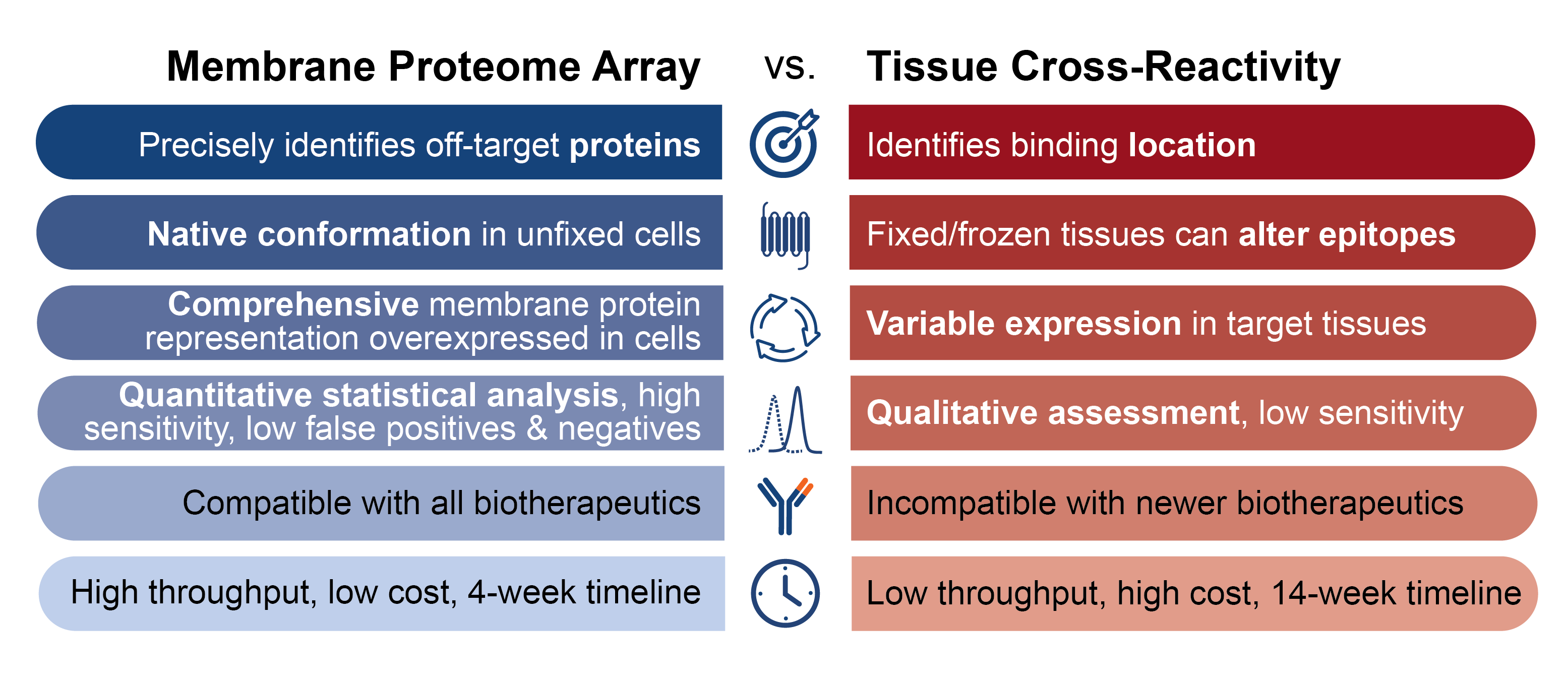
MPA features that TCR cannot match. Precisely identifies off-target proteins, native conformation in unfixed cells, comprehensive membrane protein representation, quantitative analysis, high sensitivity, and low false positives and negatives, compatible with all biotherapeutics, high throughput and low cost with 4-week timeline.