Redefining antibody patent protection using paratope mapping and CDR-scanning
A USPTO-Accepted Antibody IP Strategy for the Post-Amgen v. Sanofi Era
A claims strategy co-developed with IP attorneys
The Amgen v. Sanofi decision (598 US 594, 2023) shifted the antibody patent landscape. The decision and the follow-up USPTO guidance document (2024) clarify that antibody patents must both enable the invention (teach how to make it) and provide written description (demonstrate possession). But there is no guidance on technical approaches for meeting these requirements. This leaves antibody inventors vulnerable, with no prescribed path to robust patent protection for their valuable intellectual property.
In collaboration with antibody IP experts, we set out to apply our scientific expertise in antibody engineering and high-throughput screening to developing a solution, described in Banik et al., 2025. This is now a USPTO-accepted approach: the first patent based on Paratope-PLUS data issued in early 2026.
While our paper and our issued patent claims follow a structure-based genus claims strategy, Paratope-PLUS data is flexible and can be used for other claims strategies, such as means plus function.
How Paratope-PLUS Meets Enablement and Written Description Requirements
Paratope-PLUS delivers data inventors can use to:
- Construct genus claims around an antibody’s common structural feature
- Demonstrate both enablement and written description of the genus of antibodies in their possession
- Secure robust protection against potential infringement
- Identify substitutions with improved characteristics
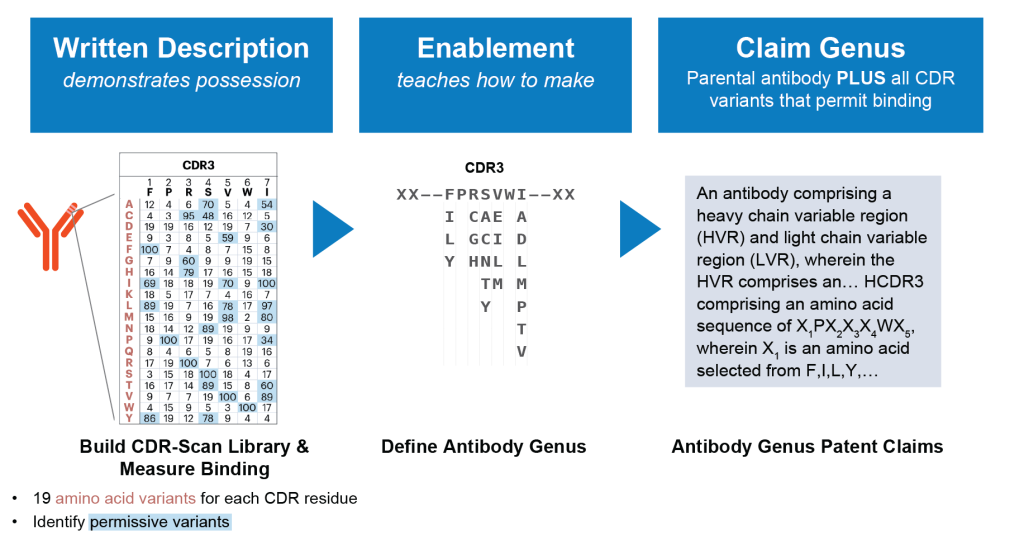
For proper enablement, the patent application must describe the invention in sufficient detail that someone with ordinary skill in the art can “make or use” the claimed invention. Further, according to the Amgen v. Sanofi decision, it should describe some “general quality running through the genus that gives rise to the claimed function.” Our Paratope-PLUS service provides this information in the form of amino acid sequences highlighting the key paratope residues (the common structural feature) and every permissible substitution.
Importantly, because a skilled artisan can readily generate antibodies with combinations of permissible single-residue substitution without undue experimentation, Paratope-PLUS data provides a sufficient roadmap to make and use not only single-mutation variants, but also multi-mutation embodiments within the claimed genus.
The written description must include enough details and examples to demonstrate possession of the invention at the time of filing. Because our Paratope-PLUS service involves making and testing every individual amino substitution in the CDRs, the resulting binding data clearly fulfills the written description requirement.
As an added benefit, Paratope-PLUS also identifies substitutions that improve antibody characteristics including expression, binding, and developability. This data provides insights for antibody engineering, including species cross-reactivity.
For more details, refer to the paper in Nature Biotech (Banik et al., 2025).