
In this article:
- Why shouldn’t specificity testing stop at the membrane?
- Why do secreted proteins require a different platform?
- What’s in the SPL?
- When should I add SPL to my MPA project?
This article is part 8 of a series about specificity testing. Be sure to read part 7, about the design of our membrane protein library.
Summary
The Membrane Proteome Array (MPA) screens biotherapeutics against the membrane proteins they could encounter in the human body. But biotherapeutics encounter more than just membrane proteins. Soluble, secreted proteins circulate through blood and tissues and can also be off-target binders, with consequences for both safety and pharmacokinetics. The Secreted Proteome Library (SPL) extends specificity testing, screening against over 1,200 soluble human proteins. Together with the MPA, it delivers the most comprehensive picture of a biotherapeutic’s protein-level interactions available today.
Why specificity testing shouldn’t stop at the membrane
The previous article described the Membrane Proteome Array (MPA) library, the foundation for specificity testing at Integral Molecular. Here we’ll focus on the Secreted Proteome Library (SPL), an important addition for any specificity testing project, and especially those bound for regulatory submission.
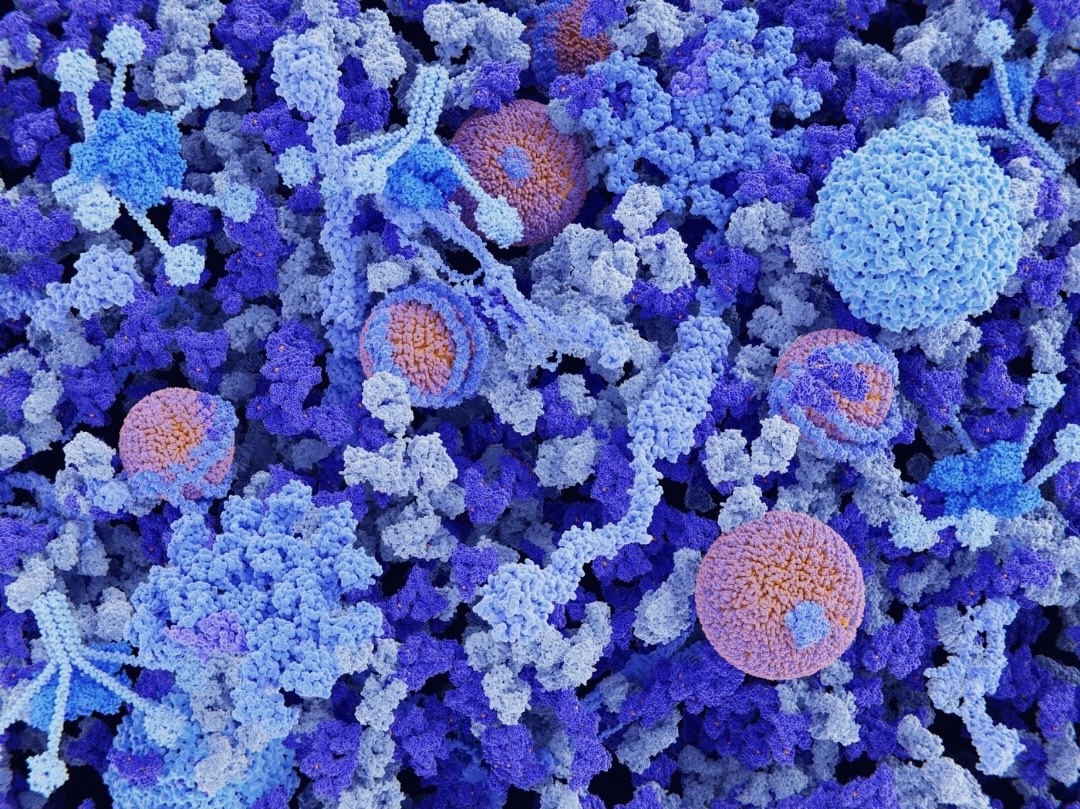
Membrane proteins are the most concentrated source of biotherapeutic targets, and they carry the highest safety risk; that’s why specificity testing has historically focused there. But circulating biotherapeutics encounter more than just cell-surface proteins. Plasma is rich with soluble, secreted proteins, and any of them can be an off-target. Importantly, in traditional tissue-based studies, soluble proteins are washed away and thus not detectable.
Off-target binding to secreted proteins is well-documented, with examples that affect safety and efficacy. As discussed in an earlier article, development was discontinued for anti-beta-amyloid antibody ABT-736 after off-target binding to a platelet factor caused acute and chronic toxicity in cynomolgus monkeys (Loberg et al., 2021). In this case, the off-target posed a safety issue. On the efficacy side, monoclonal antibodies that bind highly prevalent off-target circulating proteins can display rapid clearance, poor target tissue distribution, and limited efficacy (Bumbaca et al., 2011). These are binding events that may not register as overt toxicity, but they quietly affect how much drug reaches the intended target.
Comprehensive specificity testing that includes secreted proteins is important for identifying biotherapeutic off-targets that could affect both safety and efficacy.
Why secreted proteins required a different platform
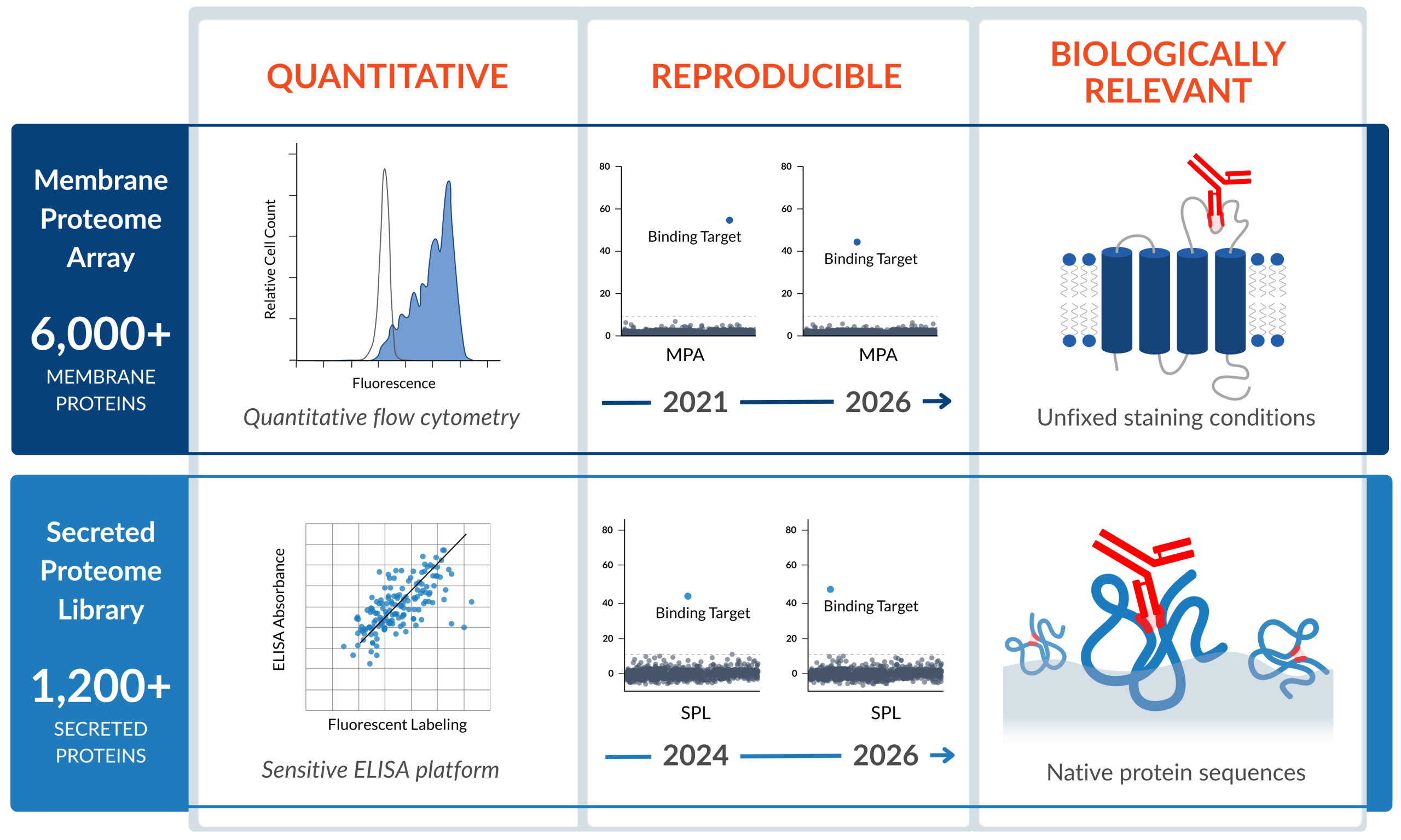
The Membrane Proteome Array (MPA) expresses each membrane protein on the surface of an intact human cell. That approach works because membrane proteins are designed to fold and function while embedded in a lipid bilayer. Soluble proteins are different: they’re secreted from the cell and they circulate as free molecules. Screening them on a cell-based platform, for example by attaching them to the membrane with a tether, would force them into an artificial context.
The Secreted Proteome Library (SPL) and its screening platform were designed from the ground up for secreted proteins. Its proteins are produced in human embryonic kidney (HEK) cells, ensuring native folding, glycosylation, and other post-translational modifications. They are then collected and screened in a cell-free, ELISA-based format under unfixed conditions, providing the optimal balance of sensitivity and reliability for soluble proteins in their native state.
This is why the SPL isn’t just an extension of the MPA. It’s a parallel platform built on the same engineering principles (native conformation, comprehensive coverage, quantitative readout, rigorous validation) but adapted to the specific demands of soluble protein biology.
What’s in the SPL?
The SPL contains over 1,200 high-confidence secreted human proteins, with a focus on the most relevant proteins for drug developers. The library includes the major functional families found in blood plasma:
- Growth factors
- Interleukins
- Chemokines
- Interferons
- Complement factors
- Proteases
Development and validation of the SPL followed the same quality framework that governs the MPA — a topic for an upcoming article.
Like the MPA, the SPL accommodates all major biotherapeutic modalities, including monoclonal antibodies, scFvs, VHHs, bispecifics, peptides, ADCs, and CAR-T cell therapies.
When should I add SPL to my MPA project?
The case for SPL screening isn’t limited to IND-stage programs. As discussed earlier in this series, the earlier in development an off-target is identified, the more options a team has for addressing it — switching candidates, engineering away the interaction, or implementing an informed safety monitoring strategy. We recommend SPL alongside MPA screening at any stage, including lead selection. The MPA addresses the membrane proteome, where most biotherapeutic targets and the highest safety risk reside. The SPL addresses the secreted proteome, where bioavailability and certain documented toxicity events also live.
Adding SPL to a specificity testing project is straightforward, and it runs in parallel with MPA screening. It includes the same dose-response validation step to confirm hits, producing high-confidence results.
The SPL is especially relevant for therapeutics that have shown unexpected bioavailability behavior in preclinical in vivo experiments. But for any IND-bound program, adding the SPL gives you the most comprehensive view of how your molecule interacts with the human body.
Looking ahead
The next article in the series moves from what’s screened to how it’s screened. We’ll walk through the four-step MPA process and the range of biotherapeutic modalities the platform supports.