


MPA+IND SERVICE FOR REGULATORY SUBMISSIONS
FDA-Recognized Off-Target Specificity Test for Biotherapeutics
Home » Membrane Proteome Array » MPA+IND Service for Regulatory Submissions
Submission-Ready Specificity Data for IND-Enabling Studies
When regulatory agencies evaluate your IND submission, they demand rigorous evidence that your drug candidate selectively engages its intended target without unexpected off-target interactions. Immunohistochemical methods often fail to detect these critical reactions, leading to potential safety risks.
Our MPA+IND service is designed to deliver the actionable specificity data that regulators are looking for. It uses the Membrane Proteome Array (MPA), our proprietary cell-based protein array, to screen drug candidates for binding against the human membrane proteome. Because the MPA uses native, unfixed conditions and delivers quantitative results, its data quality far surpasses that of any competing technology. For the most comprehensive picture of your molecule’s specificity, we also offer screening on our 1,200-protein Secreted Proteome Library.
The MPA+IND service goes several steps beyond what’s offered in our standard MPA service for lead selection. It includes additional replicates and controls, an IND-ready study report, QA documentation, audit support, and more—all on an accelerated, 4-week timeline. And regulators trust our data: it has been accepted by the FDA, EMA, NMPA, and other agencies—including in over 100 IND filings.
Built for Regulators with Input from the FDA
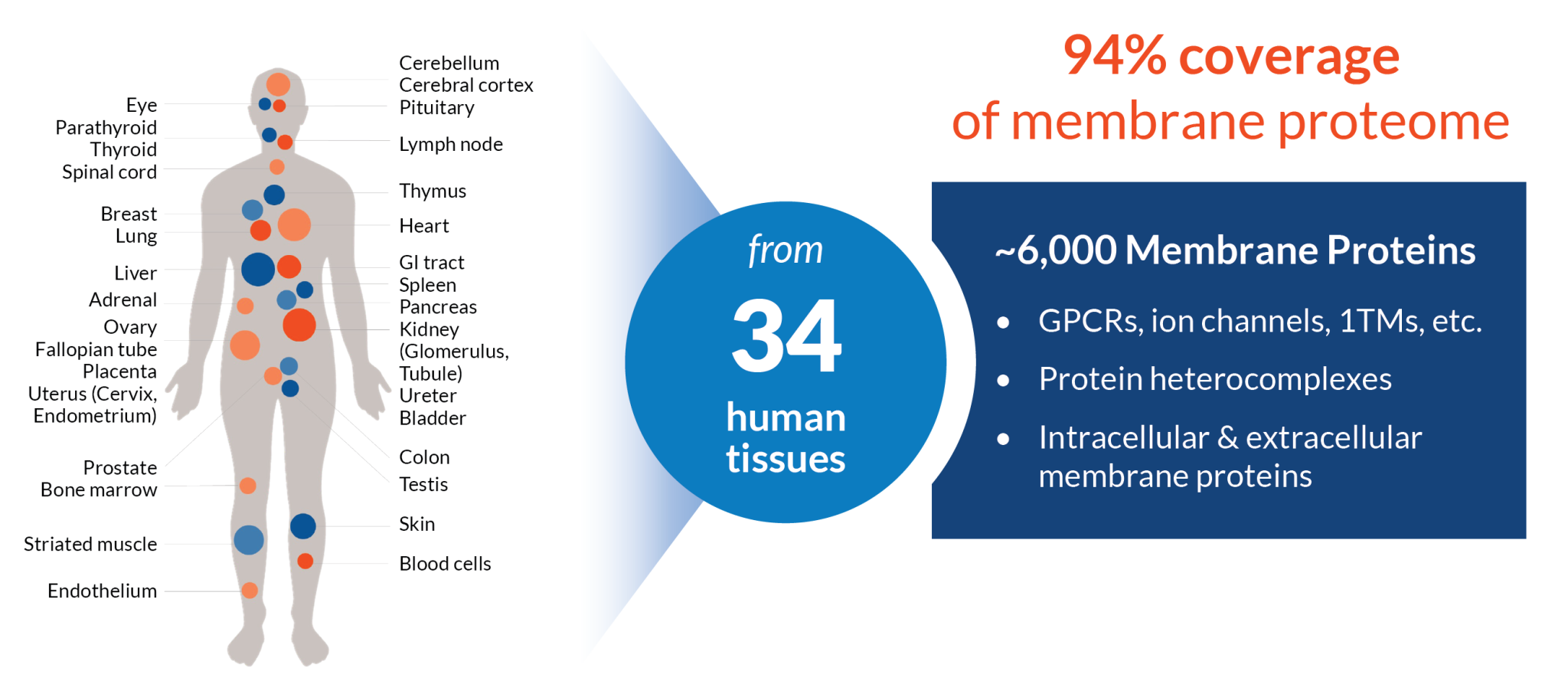
The Membrane Proteome Array (MPA) was purpose-built to meet FDA guidance on specificity testing, and it is nearing FDA qualification as a Drug Development Tool (DDT). The MPA’s 6,000-protein library is based on the membrane proteins present in all 34 tissues recommended in the FDA’s 1997 document on biotherapeutic safety. It represents 94% of the human membrane proteome, ensuring thorough coverage of potential off-target binding sites.
Since 2022, we have been working with the FDA to qualify the MPA as a DDT under the ISTAND program. Through this process, we have conducted numerous validation experiments, demonstrating that MPA results are highly reproducible, show a low false negative rate, and follow rigorous quality control practices. We have submitted all required documents and expect final FDA qualification in 2026.
To learn more about relevant regulatory guidance, the MPA’s progress toward FDA qualification, and what qualification could mean for your program, visit Using MPA Data for Regulatory Success.

Data that Exceeds what Traditional Methods Can Offer
Traditional tissue cross-reactivity (TCR) studies have been used for decades to show where in the body antibody-based therapeutics bind. Yet TCR studies alone provide limited predictive value for drug safety. They have well-known limitations (Leach et al., 2010), they can be difficult to interpret, and toxicologists say TCR results rarely impact development strategies (MacLachlan et al., 2021). Importantly, they cannot identify the specific proteins bound.
Because the Membrane Proteome Array (MPA) delivers quantitative results that precisely identify any target and off-target proteins a biotherapeutic binds, its results are immediately actionable. MPA data will be an important addition to the weight of evidence supporting your molecule’s safety profile. And if your MPA screen does reveal a validated off-target, our Enhanced Binding Analysis follow-up service provides deeper insights into its potential risks. Analyses include relative binding strength and subcellular and tissue distribution to help you assess whether the off-target protein is accessible to your drug.
To learn more about antibody off-target binding and how the MPA stacks up against TCR in detecting it, visit Antibody Polyspecificity: How to Identify Off-Target Binding for Antibody-Directed Biotherapeutics.
.png)
Project Deliverables
- Accelerated turnaround: 4-week delivery from sample receipt
- Submission-ready data package
- Validation control antibodies included
- IND-ready report
- Test sample QC (DLS)
- Enhanced statistical analysis
- IND-level quality assurance
- FDA-guided data package
- Audit support
- Complete data traceability
- QA documentation
Featured Resources
CAR-T therapy, allowing clinical studies to begin
requirements, and more
Contact Us to Get Started
MPA+IND delivers the specificity data that regulators are seeking—and it’s available for your program today. Submit the form to schedule a consultation.
Frequently Asked Questions
Standard MPA projects are ideal for selecting a lead from 4 or more molecules. Specificity testing at this early stage can help you rule out any candidates with troubling off-target binding before advancing to preclinical studies.
MPA+IND projects are best for evaluating 1-3 lead candidates that are ready for IND filing. This regulatory-ready service was developed to meet FDA requirements for data type and quality. In just 4 weeks from receipt of molecules, you’ll receive an IND-ready report to include directly in your IND submission.
Yes! While FDA qualification as a DDT will streamline and potentially accelerate your regulatory review process, agencies worldwide already routinely accept MPA data in regulatory submissions, including over 100 for IND.
All of our specificity testing is conducted in our state-of-the-art facility in Philadelphia, PA, USA, using ISO 9001 certified processes.
For any hits identified in your initial MPA screen, we will conduct a validation study using a dose-response titration experiment to rule out any false positives. Validation is included in every project.
While not every validated off-target poses a problem for drug development, we strongly recommend that you perform follow-up studies to gain further insights into any off-target interactions that do validate. Our Enhanced Binding Analysis service is designed specifically for this purpose. With cellular localization, relative binding strength, and statistical power, it provides the data you need to inform further drug development decisions.
Yes, cross-reactivity screening is required for IND and BLA applications. Specificity testing is especially important for cell-killing modalities, such as ADCs and CAR-T cell therapies. And yes, our MPA+IND service satisfies this requirement. In 2024, the FDA published the guidance document, Considerations for the Development of Chimeric Antigen Receptor (CAR) T Cell Products. It states, “unintended targeting of other antigens expressed on healthy/normal tissue is a safety concern that may be evaluated using in vitro and/or in vivo studies.” Protein arrays (of which the MPA is one) are listed as an example of such a study.
The MPA+IND service provides an IND-ready study report that is designed to be directly incorporated into an IND safety package. MPA data has successfully been used in over 100 IND submissions to satisfy cross-reactivity testing requirements.
Yes, MPA+IND data has been used to provide specificity profiling for regulatory submissions globally, including to the FDA (US), EMA (Europe), PMDA (Japan), and NMPA (China).
MPA data has been successfully used in a broad range of IND submissions. Some customers have used it to supplement older methods like TCR studies, and some have used it as the sole specificity assay.
Please contact us with questions; we would be happy to share our experiences with you. Since each case is different and regulatory guidance continues to evolve, we also recommend that you discuss the exact requirements for your IND submission with the FDA.
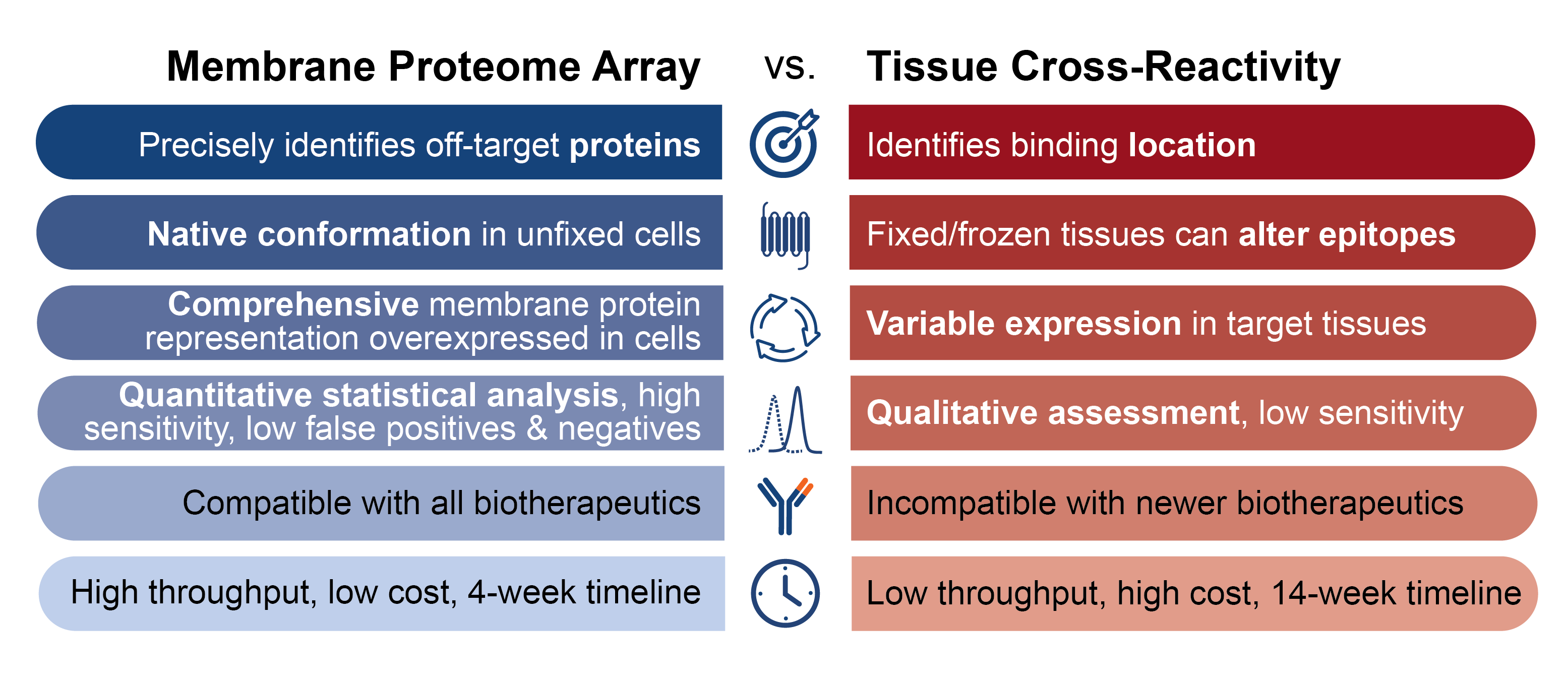
The chart below summarizes the main differences.
A critical difference is that MPA precisely identifies your molecule’s binding partners whereas TCR studies identify only its binding locations. By providing specific binding identities, MPA screening enables follow-up studies that can more accurately assess the physiological relevance or potential toxicity of any off-target interactions.
Other key MPA features include quantitative flow-cytometry detection, high sensitivity, low false positive rates, lower cost, and faster turnaround time.
Home » Membrane Proteome Array » MPA+IND Service for Regulatory Submissions
Specificity testing of antibodies and other biotherapeutics for regulatory submissions
Investigational new drug (IND) applications for biotherapeutics require detailed assessment of off-target binding for safety profiling. The availability of rapid, affordable, and reliable methods to assess binding specificity has been an issue for developers of antibodies and other biotherapeutics1. Tissue cross-reactivity (TCR) studies have traditionally been used despite incompatibility with some advanced biotherapeutic modalities and frequent difficult-to-interpret false positives2.
Developers are increasingly adopting newer technologies such as the Membrane Proteome Array (MPA) to provide detailed specificity profiling information required in regulatory filings3. MPA data have been used in numerous successful regulatory applications, and may be used in lieu of, or to complement other cross-reactivity studies.
See Norden and Doranz, 2021 for an in-depth discussion of the MPA
IND-Ready Study Report
The MPA is a cell-based platform that provides detailed specificity information by testing molecules against an array of ~6,000 human membrane proteins expressed in unfixed cells. For comprehensive data, you can also add screening on 1,200 secreted proteins. To support our customers who require this information for regulatory filings, we offer the MPA+IND level of service. MPA+IND includes all the same high-quality data as the standard MPA service; however, it additionally provides:
- A full IND-ready study report that can be directly incorporated into an IND safety package
- Additional isotype controls to further validate binding interactions
- Data traceability and auditability
- Up to 5 hours of post-project and audit support
MPA+IND Services
MPA | MPA+IND | |
|---|---|---|
Testing against 6,000 membrane proteins & (optional) 1,200 secreted proteins | ✔ | ✔ |
Testing in duplicate | ✔ | ✔ |
Epitope tags to ensure protein expression | ✔ | ✔ |
Native binding conditions (unfixed cells) | ✔ | ✔ |
Flow cytometry detection for sensitivity | ✔ | ✔ |
Assay setup for optimal conditions | ✔ | ✔ |
Hit validation curve to confirm reactivity | ✔ | ✔ |
Turnaround time | within 8 weeks | 4 weeks |
Additional isotype or validation control antibody | – | ✔ |
IND-Ready study report | – | ✔ |
Audit support | – | ✔ |
IND-enabled data tracking | – | ✔ |
IND-traceable SOPs | – | ✔ |
QA documentation of personnel | – | ✔ |
QA documentation of equipment | – | ✔ |
Records retention | 3 years | 10 years |
Services may vary slightly depending on customer location.
References
- Cunningham, O. et al. (2021) Polyreactivity and polyspecificity in therapeutic antibody development: risk factors for failure in preclinical clinical development campaigns. mAbs. 13(1): E1999195.
- Norden, D. and Doranz, B. Testing for Off-target Binding. In: Cavagnaro, JA., and Cosenza, ME. Translational Medicine: Optimizing Preclinical Safety Evaluation of Biopharmaceuticals. CRC Pres; 2021. doi.org/10.1201/9781003124542.
- MacLachlan, T.K. et al. (2021). Industry experiences with immune-mediated findings in biotherapeutic nonclinical toxicology studies. Regul Toxicol Pharmacol. 119:104825.
The MPA Is Approaching Full FDA Qualification as a Drug Development Tool (DDT)
The Membrane Proteome Array was the first tool to be accepted into the FDA’s ISTAND program, in 2022, and it’s the only cell-based protein array with an approved qualification plan. To learn more about the qualification process, why the FDA is encouraging the use of New Approach Methodologies (NAMs) like the MPA, and what this means for you, visit the link below.
Frequently Asked Questions
Cross-reactivity screening is required for IND and BLA applications. Demonstrating a lack of off-target binding is especially important for therapeutic modalities with high cell-killing potential such as CAR-T cell therapies. The MPA+IND service provides an IND-ready study report that is designed to be directly incorporated into an IND safety package, and has successfully been used in IND submissions to satisfy cross-reactivity testing requirements.
Yes, many of our customers use the MPA for screening of their T-cell therapeutics (including CAR-T, CAART, and bicistronic CAR vectors). We have several screening options available for screening CAR-T modalities. Please contact us to discuss screening of your T cell therapeutic.
Cell arrays, such as the MPA, are increasingly used and accepted by the FDA for specificity screening of most biotherapeutics. In some cases, cell array was the sole assay used in approved IND applications and no TCR data were submitted (MacLachlan et al., 2021).
The MPA precisely identifies cross-reactive binding partners whereas TCR studies identify tissues where the test article binds, without specifying the binding proteins involved. By providing specific binding identities, the MPA screen enables follow-up studies that can more accurately assess the physiological relevance or potential toxicity of any off-target interactions. The MPA uses unfixed cells which present targets in their native conformations and enables the most accurate assessment of relevant binding interactions. Other differences include flow-cytometry detection, high sensitivity, and low false positive rates.
MPA data can be used to provide specificity profiling for regulatory submissions globally, including to the FDA, EMA, PDMA and NMPA.
Case Study
Learn How Cabaletta Bio Used the MPA for a Successful IND Submission
Autoantibodies against desmoglein 3 (DSG3) cause painful mucosal blisters in mucosal pemphigus vulgaris (mPv). Cabaletta Bio developed DSG3-CAART (Chimeric AutoAntibody Receptor T cell) therapy to eliminate these autoantibodies by targeting the corresponding pool of antigen-specific B cells. To progress the clinical development, Cabaletta Bio needed to demonstrate the specificity of DSG3-CAART and document the lack of off-target interactions for their IND submission.
Contact Us
Towards IND: Specificity Profiling of Antibody Therapies Using the Membrane Proteome Array
Webinar Agenda
- Re-examine the long-held assumption that antibodies are exquisitely specific
- Learn what to do next if your molecule shows detectable off-target binding
- Discover how Membrane Proteome Array specificity data is used to satisfy regulatory requirements


