USPTO Allows Antibody Genus Claims in Patent Enabled by Integral Molecular’s Paratope-PLUS™ CDR-Scanning
Data-Driven Technology Re-establishes a Pathway for Antibody Genus Claims that Meet US Patent Requirements
Philadelphia – Integral Molecular, the industry leader in the discovery and engineering of antibodies against membrane proteins, announces that the United States Patent and Trademark Office (USPTO) has allowed a patent covering a genus of antibodies1 enabled using the company’s Paratope-PLUS® CDR-Scanning technology. The allowed claims protect a lead candidate and a family of structurally related antibodies binding the cancer target GPRC5D that share a common ‘paratope’ structural feature that is responsible for target binding.
The issued patent demonstrates a new pathway for protecting antibody genera using structure-based claims supported by comprehensive experimental data, based on Integral Molecular’s 2025 publication in Nature Biotechnology2. The allowance comes in the wake of the 2023 U.S. Supreme Court ruling in Amgen Inc. v. Sanofi, which emphasized that genus claims must be supported by sufficient disclosure under 35 U.S.C. §112 for enablement and written description. These requirements are met, according to the courts, by defining a common structural feature of the genus (the paratope in this case).
Learn how Paratope-PLUS® CDR-scanning can protect antibody intellectual property
Experimental Data Enables Structure-Based Genus Claims
To generate data enabling genus claims, the Paratope-PLUS platform was used to mutate each residue of the antibody’s CDRs (Complementarity Determining Regions) to all 19 possible alternate amino acids. The resulting experimental dataset identified every variant that retains or even enhances function. CDR-Scanning uses a strategy that mirrors small molecules, claiming a core structural feature (the ‘scaffold’ of a chemical or the ‘paratope’ of an antibody) and all of the permissible variants around that core feature (‘R’ groups of a chemical or amino acid variants of an antibody). The allowed GPRC5D antibody genus claims encompass variants with individual mutations, as well as combinations of mutations that provide permissible levels of binding.
When asked about a path forward for genus claims, Integral Molecular CEO Benjamin Doranz explained, “Big data is transforming both how antibody drugs are being developed and how they are protected in patents. We’ve collaborated with IP experts to create a data package aligned with USPTO guidance to once again provide robust IP protection for antibodies. With today’s high-throughput capabilities, this strategy is now affordable and scalable.”
Paratope-PLUS provides:
- Laboratory-generated expression and binding data for every antibody variant
- A genus of structurally related antibodies that meet enablement and written description requirements for broad patent claims
- Draft claim sets included with the final data report
- Data describing variants with improved expression, binding, and developability, providing the basis for antibody engineering and novel claims
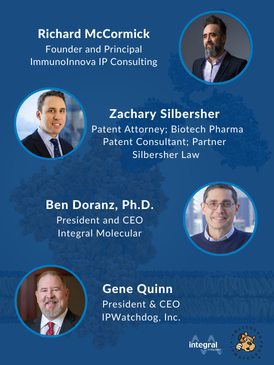
Benjamin Doranz will discuss the application of CDR-Scanning to antibody intellectual property at the upcoming Life Sciences Patent Network conference on April 29, 2026. He also presented on this strategy in the Resurrecting Antibody Genus Protection webinar, recently hosted by IP Watchdog.
References
- U.S. Patent 12,545,726 B1. Compositions and methods related to GPRC5D binding agents and variants thereof.
- Banik et al. Redefining antibody patent protection using paratope mapping and CDR-scanning. Nat Biotechnol 43:170–174 (2025).
About Integral Molecular
Integral Molecular (integralmolecular.com) is the industry leader in developing innovative technologies that advance the discovery of therapeutics against difficult protein targets. With 25 years of experience focused on membrane proteins, viruses, and antibodies, Integral Molecular’s technologies have been integrated into the drug discovery pipelines of over 600 biotech and pharmaceutical companies to help discover new therapies for cancer, diabetes, autoimmune disorders, and viral threats such as SARS-CoV-2, Ebola, Zika, and dengue viruses.
Follow Integral Molecular on LinkedIn
Press Contact:
Integral Molecular
Soma Banik, PhD, Director of Public Relations
215-966-6061
info@integralmolecular.com