
MPA Case Study
FDA Accepts MPA Specificity Data in IND Application for Novel CAR-T Therapy, Allowing Clinical Studies to Begin
Home » Membrane Proteome Array » FDA Accepts MPA Specificity Data in IND for CAR-T Therapy
The Need: Off-Target Screening for an IND Application
Claudin 18.2 (CLDN18.2) is expressed at high levels in many solid tumors, including pancreatic and gastric, making it a promising target for cancer biotherapeutics.
To target CLDN18.2-positive solid tumors, researchers at Triumvira developed a novel CAR-T immunotherapy. It relies on a chimeric T-cell antigen coupler (TAC) that includes an anti-CLDN18.2 VHH (nanobody) for targeting, and an anti-CD3ε domain for recruiting and activating T-cells. This novel therapy has long-lasting antitumor activity while triggering lower levels of cytokine release than traditional CAR-T therapies—key advantages for targeting solid tumors.
For cell-killing modalities, including CAR-T and related therapies, specificity for the intended target is especially important—and the FDA requires it*. Specificity was a particular concern for this project, as CLDN18.2 differs by only a few amino acids from related isoform CLDN18.1. To ensure the safest treatment possible and a successful IND application, the team needed a way to test their molecule for off-target binding.
*In early 2024, the FDA published the guidance document, Considerations for the Development of Chimeric Antigen Receptor (CAR) T Cell Products. It states, “unintended targeting of other antigens expressed on healthy/normal tissue is a safety concern that may be evaluated using in vitro and/or in vivo studies.” Protein arrays are listed as an example of such a study.

The Solution: The Membrane Proteome Array™ for Sensitive, Biologically Relevant Specificity Data
The Triumvira team chose the Membrane Proteome Array™ (MPA) for specificity testing. The MPA is a unique cell-based protein array that individually expresses over 6,000 human membrane proteins in whole, unfixed cells for biologically relevant data. Unlike conventional tissue cross-reactivity (TCR) studies, the MPA is highly sensitive and compatible with all biotherapeutic modalities.
Consistent with FDA guidance, screening on the MPA was performed using just the targeting domain. The anti-CLDN18.2 VHH was fused with GFP for detection and screened on the MPA.
MPA screening revealed that the molecule was highly specific for CLDN18.2, with no cross-reactivity across the human membrane proteome, including to any of the other claudin family members.
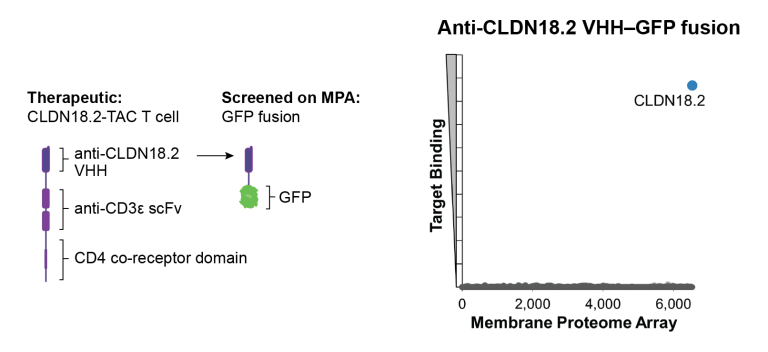

Data featured in Xu et al., 2025 (Supplemental Figure 1).
The Outcome: Novel CAR-T Therapy Approved for Clinical Trials
With confirmation that their therapeutic specifically targeted CLDN18.2, the team could confidently proceed with development, including testing in primary cells and animal tumor models. When the team submitted their IND application, they included their MPA specificity testing data—which the FDA accepted.
The therapy, TAC01-CLDN18.2, entered clinical testing in a Phase I/II trial for patients with CLDN18.2-positive tumors (NCT05862324).